The process of sexual reproduction
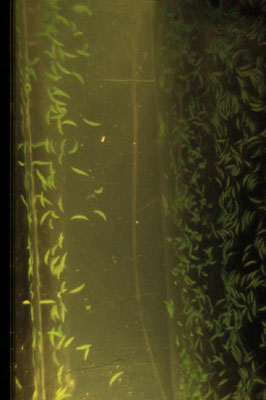
| migration of mating cells of Closterium ehrenbergii | ||
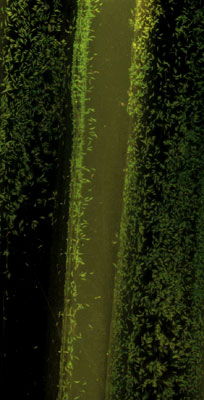 |
Left: An agar strip (ca 5 mm in breadth) separates suspensions of + (left) and – (right) cells of Closterium ehrenbergii. + Cells are penetrating the agar strip, moving towards the – cells. Right: Idem, in detail. (more information in Coesel & De Jong, 1986) |
|
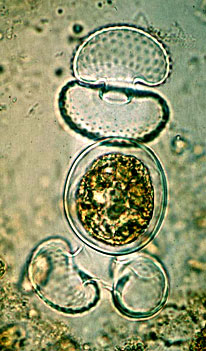
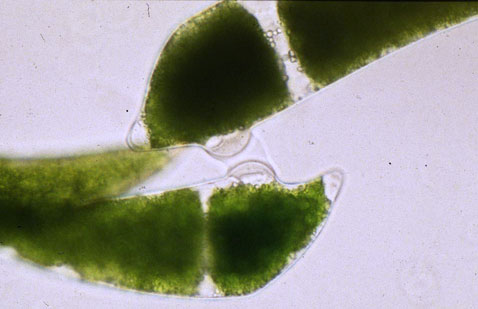
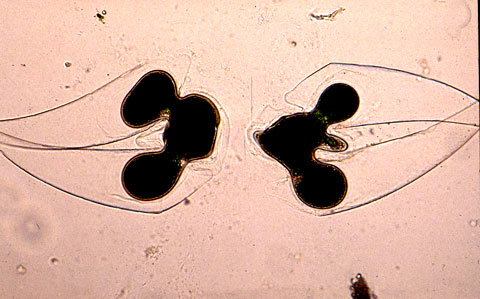
| When partner cells have approached each other closely enough, the process of conjugation may evolve: partner cells functioning as gametangia break open (usually at the isthmus), protoplasts functioning as gametes move out and mutually fuse to a diploid zygote. The zygote develops a thick, resistant wall which (dependent on the species) may be furnished with projections like tubercles or spines. Semicell walls of the empty gametangia often adhere the zygospore for some time. |
 |
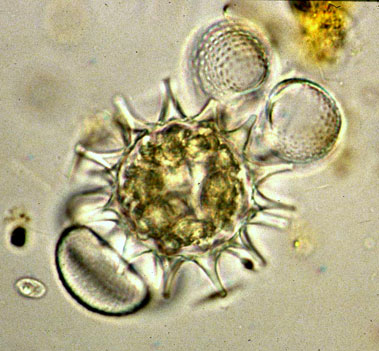 |
| Smooth-walled zygospore of Cosmarium reniforme with adhering empty gametangial cells. | Spiny zygospore of Cosmarium botrytis with adhering empty gametangial cells. both images © Peter Coesel |
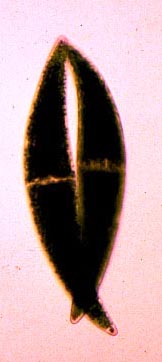
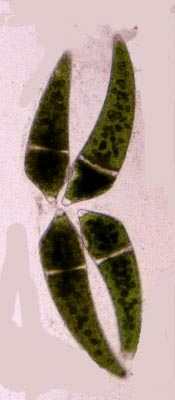
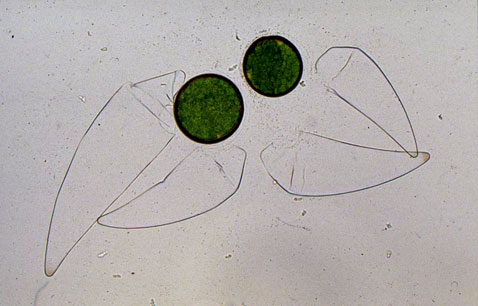
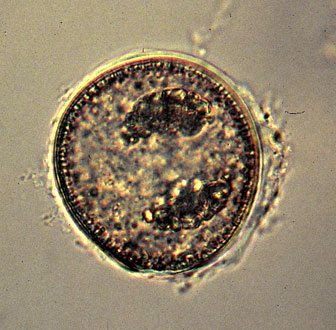
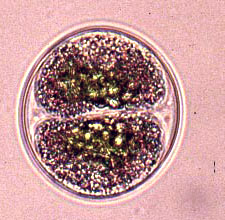
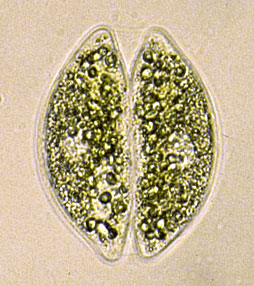
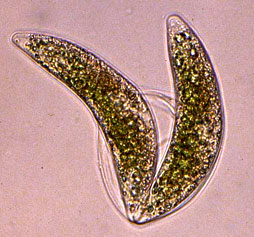
Detailed sexual cycles, at best to be studied in culture, are known from but a few species (see also Brook, 1981). One of the species studied is Closterium ehrenbergii, characterized by the formation of twin zygospores. Twin zygospores are formed when partner cells undergo cell division immediately before conjugation so that actually four cells, lieing close together, participate in the mating process. |
|
|
|
 |
|
 |
|
 |
|
|
|
|
|
|
|
|
|
|
 |
home |
|
references:
|